

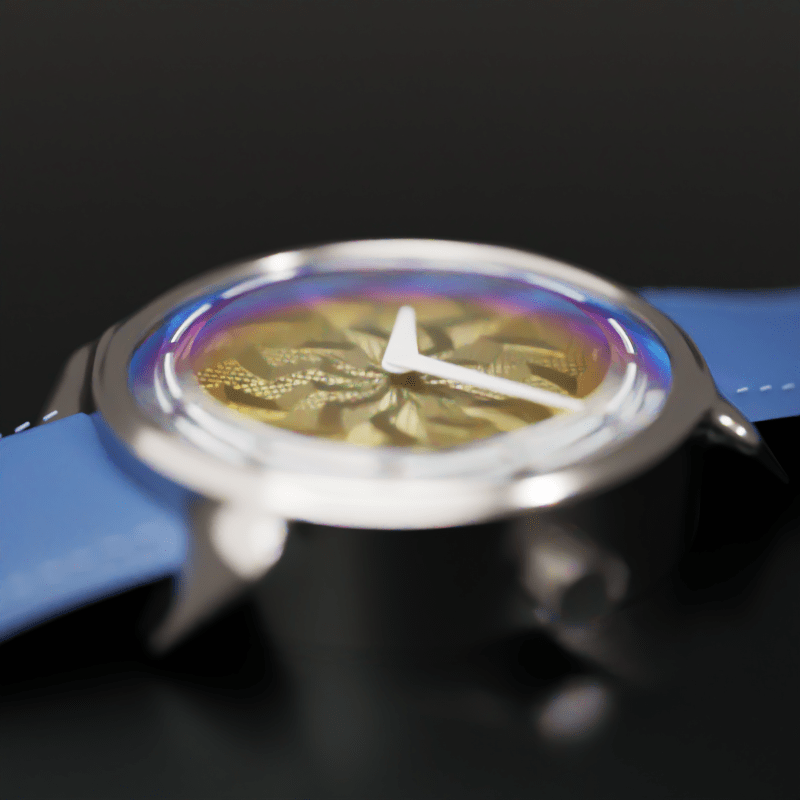
In early June, Ming and J.N. Shapiro released a watch called the 37.06 Lightning, and the first batch was claimed the same day it was announced. It is a grade-2 titanium dial, hand-engraved on a rose-engine lathe in Josh Shapiro‘s Los Angeles workshop, then hand-colored with a butane torch by Ming Thein in Kuala Lumpur. At around 6,250 Swiss francs it is, improbably, the least expensive way into one of Shapiro’s engine-turned dials. The color runs from warm golds and oranges at the centre, through purple in the middle, to a deep blue at the rim. It is not paint. It is oxidation, controlled by temperature, executed by eye, and a large share of the dials get thrown away because the color lands wrong.
This fired up a burning question: why does it look like that? The color is not pigment, the pattern is not printed, and the whole thing is doing something with light that I could feel I didn’t fully understand. The honest way for me to understand a watch like this is not to keep staring at the beautiful photography on the Ming website; it’s to try to rebuild the light that comes off it, and to find out exactly where my mental model is thinner than the dial.
Three weeks of evenings and some weekends later, RISE had grown a thin-film optics stack, its first implicit-geometry primitive, a deferred scene-realization pass, an HDR movie pipeline, and a small pile of bugs that were each more interesting than the feature that surfaced them. This is the account of that, dead ends and all. If you want the short version: the renders were never the point. The point was that the watch stopped being opaque to me.
The watch poses three mysteries, and they map cleanly onto three pieces of physics. There is the color, which is interference. There is the pattern, which is kinematics. And there is the problem of making the light actually play across the thing, in motion, without lying about any of it. I went after them in that order.
I. The color is not paint
The first real decision was a modelling one, and getting it right saved me a refactor I would have regretted.
Heat tint and anodization look like a surface treatment, like a coat of something. They are not. Physically, the color is the specular reflectance of an air-oxide-metal stack: a thin, coherent dielectric film (the oxide) sitting on a conductor (the titanium). When white light hits it, part reflects off the top of the oxide and part off the metal underneath, the two paths differ in length by an amount that depends on the film thickness and the wavelength, and they interfere. Thicken the oxide by tens of nanometres and you walk the constructive peak across the visible spectrum, which is why a torch sweeping a dial paints gold, then purple, then blue as the metal gets hotter and the oxide grows. The color you see is the surviving wavelengths after interference, not a dye.
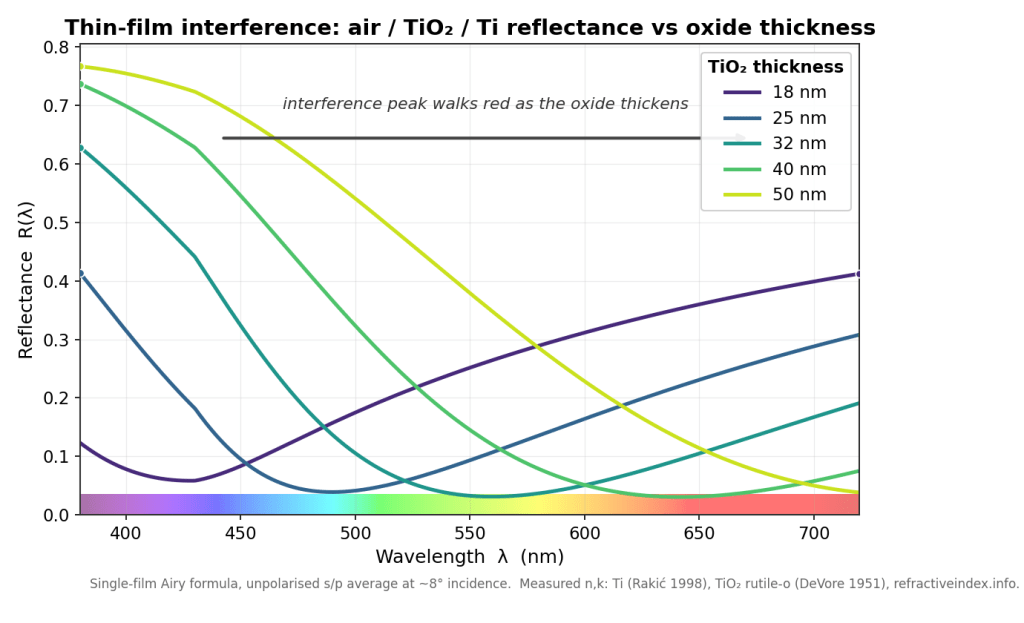
That single fact tells you where the feature belongs. The bare-metal reflectance already lives on RISE’s microfacet specular lobe, computed in exactly one place. Anodized color is the same Fresnel calculation with one extra layer in front of the metal, so it is not a new material type at all; it is a third Fresnel mode on the lobe that already exists.
enum FresnelMode { eFresnelConductor, eFresnelSchlickF0, eFresnelThinFilmConductor };
This is also, pleasingly, the industry-standard surfacing. glTF calls the same thing KHR_materials_iridescence: a base metal plus an iridescence layer with a film index of refraction and a film thickness. RISE’s new slots map onto that one for one, so the material imports and exports glTF iridescence for free, which I did not plan and was glad to have. What it is explicitly not is a clearcoat (that is a thick, incoherent dielectric, a separate lobe) and it is not a color-gradient painter (RISE has one of those, a cosmetic lerp, and the design doc carries a literal warning not to mistake the two). The temptation to model a color gradient as a color gradient is strong and wrong; the gradient is a side effect of physics, and if you model the side effect you spend forever hand-tuning something the physics would have handed you.
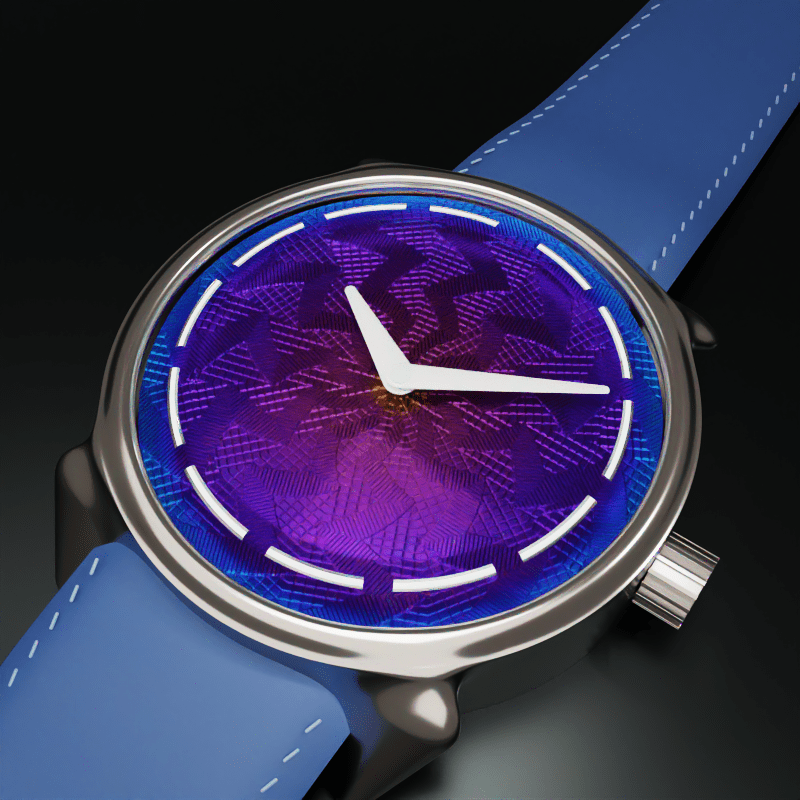
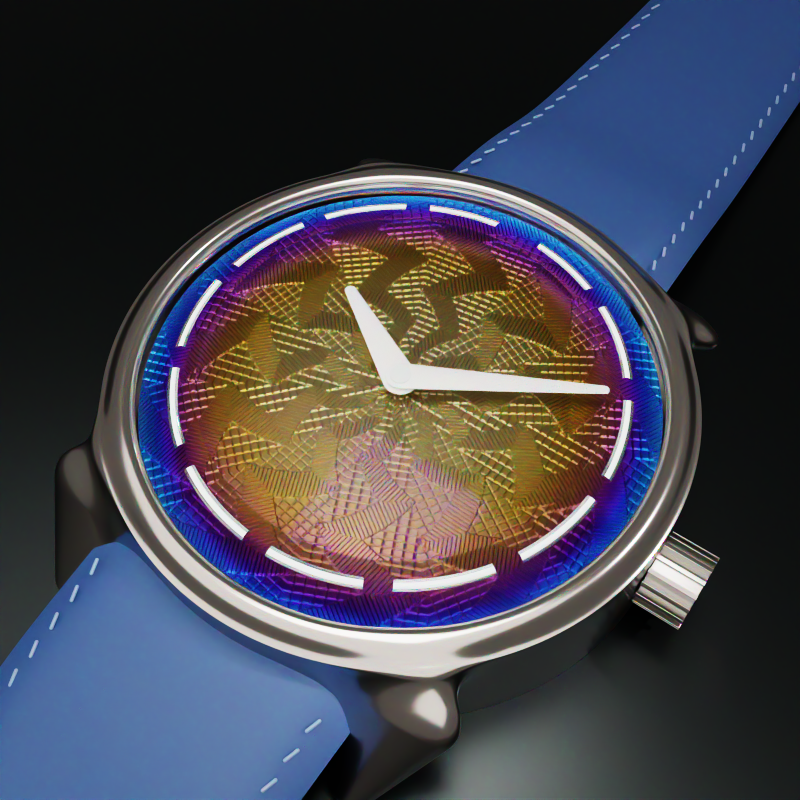
Why a spectral renderer makes this trivial
Here is the architectural fact that made the whole project tractable, the one I would put on the first slide. RISE does not carry red, green, and blue. Its primary integration path carries hero wavelengths: each camera path samples a small set of wavelengths (the watch uses sixteen across 380 to 720 nm), and a material is asked for its reflectance at a wavelength. Interference lives in the phase term δ = 2πnd/λ, an explicit function of wavelength. A spectral renderer evaluates the real reflectance R(λ) at each hero wavelength and is exact by construction. An RGB renderer is asked to represent that same interference integral with three point samples, which is roughly like trying to reconstruct a chord from three keys chosen in advance; you can fake an average color but you cannot get the spectral structure right, and thin-film is spectral structure. If you have ever wondered why iridescence is the thing that makes RGB renderers look subtly wrong, that is why.
So the spectral path needed no clever antialiasing, no famous paper. The famous paper here is Belcour and Barla (2017), which is the reference for thin film in a renderer, and the survey’s conclusion was that RISE does not need it on the spectral path. Belcour integrates in optical-path-difference space precisely because they cannot carry wavelength in an RGB engine; RISE can, so it just evaluates the truth. Knowing not to implement the famous paper was one of the better decisions. Their machinery does reappear, in a simplified form, on RISE’s RGB convenience path, which still has to fake the integral for tools that want a quick preview.
Implement the oracle twice
Phase one was deliberately standalone, no renderer integration at all. The point was a ground truth, and the discipline was to implement the optics twice and force the two to agree.
One implementation is a general N-layer transfer-matrix method (characteristic matrices, per-polarisation). The other is the closed-form Airy summation for a single film. With one layer, the transfer-matrix result reduces algebraically to the Airy result, so the two must match to machine epsilon or one of them is wrong. This redundancy is the entire point: a single implementation is internally consistent with its own mistakes, and the classic thin-film bug is a sign-convention slip in the p-polarisation branch that a lone implementation will reproduce identically in both its “check” and its “answer,” agreeing with itself all the way to a confidently incorrect render.
It paid off immediately and a little embarrassingly. The cross-check, 6,086 assertions worth, caught a sign-convention inconsistency in my own design doc: a mismatch between the forward-travelling cosine root, the matrix off-diagonal sign, and the Airy round-trip exponent. Pair the wrong two and you get a wave that grows instead of decays, and reflectance greater than one for an absorbing film, which is the universe’s way of telling you that you have invented a laser. The energy invariant (R must lie in [0,1]) and the transfer-matrix-versus-Airy comparison are both built to catch exactly that, and they did. The validated convention got pinned down and written into the doc, and the production evaluator, lifted from the Airy form, now matches that oracle to within 3.3e-16. Adversarial review found one more real bug before it shipped: a grazing-incidence NaN at cosθ = 0, fixed with an input clamp that leaves the valid domain bit-identical to the oracle, plus a sign-mutation test to prove the oracle comparison isn’t tautological. (If your test passes when you deliberately corrupt the thing it tests, your test is decorative.)
Generality is a data file
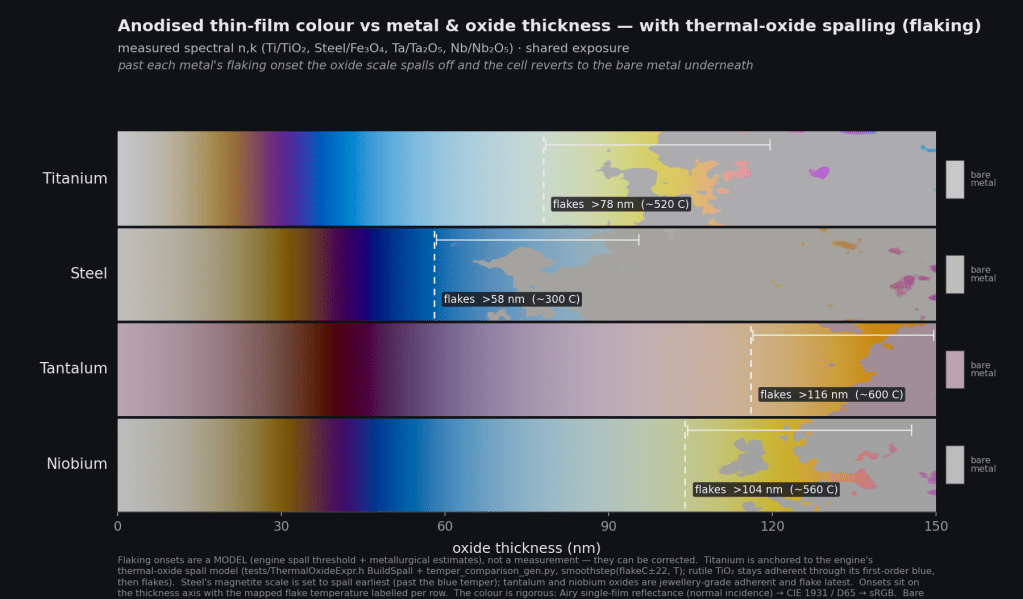
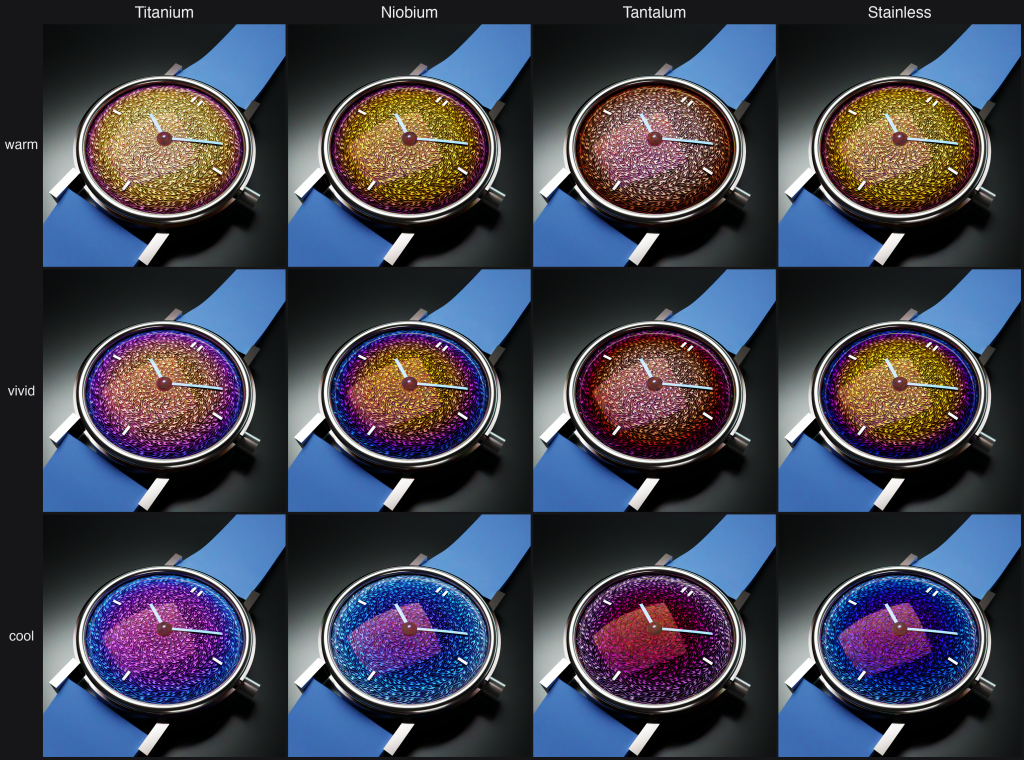
The hard requirement I set was that adding a metal must be data only, no code. The optical maths is N-layer from day one, so a new metal is a pair of measured optical-constant files (n and k) for the substrate and another pair for its oxide, dropped straight in from refractiveindex.info. The shipped set covers titanium with its TiO₂ oxide (the canonical case, the oxide is transparent in the visible), steel with magnetite (Fe₃O₄, which is absorbing, so it gives the duller, browner temper ladder you see on heat-blued screws), tantalum with Ta₂O₅, and niobium with Nb₂O₅ (the classic anodized-jewellery palette). Steel’s absorbing oxide is the coverage win: it exercises the complex-film-index path that titanium, with its near-zero absorption, barely touches. The human acceptance gate is therefore a single grid, metal down one axis and thickness across the other, that proves generality and stress-tests transparent against absorbing films in one image, and pins the D65 white point dead on while it is at it. The watch ships titanium, but the scene also defines the niobium, tantalum, and steel variants, swappable in the GUI, purely as authored data.
However, this is all pure theory, in practice, what happens with each of these metals is that once the temperature reaches a certain point, the oxide layer flakes off. This makes the physical effort that someone like Ming Thien has to go through to get just the right color even more daunting, push the temperature just a little too far and you’ve wasted the whole dial. This is also why for stainless steel, to get that blue color it’s typically anodized which allows precise oxide layer thickness but then you get none of that color gradient.
Two parallel pipes, and why IOR can’t go through the color one
This is the kind of detail that reads as trivia until it silently mangles a render. RISE has two parallel painter interfaces, and the split is load-bearing. One pipe carries color: reflectance, emission, anything tinted, and on the spectral path it uplifts an inline RGB value to a full spectrum through a learned lookup table (the Jakob-Hanika method). The other pipe carries physical scalars: index of refraction, roughness, scattering coefficient, film thickness. It never touches the uplift; it returns a per-wavelength magnitude directly.
The film parameters (film_ior, film_extinction, film_thickness) go through the scalar pipe for the same reason index of refraction does: routing an IOR of 2.7 through the color pipe would “uplift” it as if it were the color (2.7, 2.7, 2.7), handing you whatever spectrum the table thinks that means, which is nonsense. The historical version of exactly this bug is instructive: a scattering coefficient of one million, sent through the color pipe, got clamped to about 1.0 in the visible band, which rendered glass spheres invisible in every spectral mode for longer than I would like to admit. The rule, now written down, is a one-liner. Is it a tinted reflectance sample? Color pipe. Is it a physical coefficient? Scalar pipe. And never add a color accessor to the scalar pipe to “fix” something, because the absence of that path is the entire safety property. The type system is the correctness guard; encode the physical meaning in the type, not in a runtime check you will forget to write.
The bug that lived in two places at once
Two correctness bugs from this stretch are worth telling because of how they were found, not just what they were.
The first is an energy-conservation subtlety. Rough metals lose energy at each microfacet bounce, and a good renderer adds it back with a multiscatter compensation term. The term is nonlinear in the Fresnel reflectance. The draft pulled the metal’s tint outside that nonlinear function, which over-brightens tinted rough metals because the tint actually compounds through the multiscatter series and has to go inside. Measured, the tail was about 4.3 times too bright at a tint of 0.3. The fix is a one-line rearrangement. The interesting part is what came next.
Once you can state a bug in a single sentence (“the multiscatter tail pulls the tint outside the nonlinear term”), you can enumerate every place that sentence could be true. That compensation function has exactly two callers in the codebase: the GGX material I was working in, and the older Cook-Torrance material I was not. Cook-Torrance carried the identical bug. It was fixed in the same breath. The lesson, which I have started calling audit-by-bug-pattern, is that a fix is not done when the reported site is fixed; it is done when no sibling carries the same pattern. The reported site is a sample, not the population.
The second bug is a foundation I inherited from my own past. The thin-film-aware hemispherical Fresnel average was measured before it was implemented: a furnace test showed that ignoring the film and using the bare-substrate average was off by up to 0.50, a thirteen-percent albedo error on rough surfaces, because the oxide is strongly anti-reflective at some thickness-wavelength combinations. So it got implemented properly, sharing the existing integration rule so that the film-equals-air case stays byte-identical to the bare conductor. Measure first, then decide whether you even have a problem; I had assumed this one was negligible and the furnace told me it was not.
The color foundation under all of it
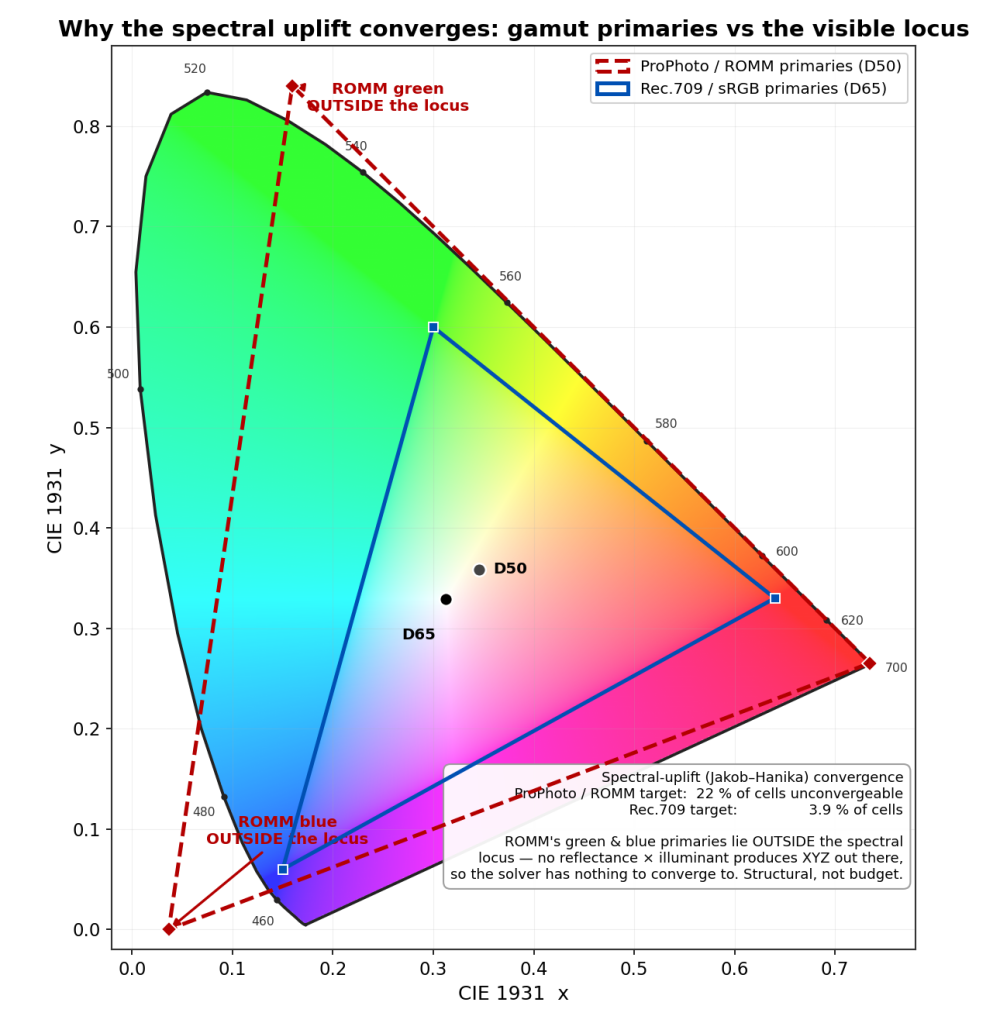
None of the color would have been trustworthy without a change I had made just before this work, almost as housekeeping. RISE’s internal working color space had been ProPhoto (a wide-gamut space with a D50 white point), and that was quietly poisoning the spectral uplift. ProPhoto’s green and blue primaries lie outside the spectral locus, which means a chunk of its color cube corresponds to colors no physical reflectance can produce, and the uplift solver had 22 percent of its cells unconverged. This is not a solver-budget problem; there is literally nothing for the solver to converge to in those cells. I tried a smarter solver, more iterations, a different training illuminant; all marginal, because the problem is structural, not numerical. The fix was to retrain against Rec.709 linear, whose primaries all sit inside the locus. Failures dropped to 3.9 percent, all in the deep-blue corner where the underlying sigmoid model itself runs out of expressive power, and the residual is comfortably below the display quantum. So by the time the watch rendered, the swatch I tuned color against and the image the renderer integrated lived in the same Rec.709/D65 space, which is the only reason the two ever agreed. The lesson is dull and important: get your color space honest before you trust a single color you measure in it.
II. The pattern, and the wall
Guilloché looks like ornament. It is closer to a mechanical recording of a motion.
A rose engine is a lathe whose headstock can rock side to side, steered by a shaped cam called a rosette as the workpiece turns. Run a cutter against the rocking face and it traces one wavy line per revolution; feed the cutter slowly inward and the lines stack into the pattern. So the “design” is not drawn, it is the trace of a kinematic system, and once you see it that way the whole field collapses into a little maths. A rosette with some number of lobes rocks the radius by an amplitude as the angle sweeps, which gives a phase field ψ = (r − amp·cos(lobes·θ)) / pitch, and the groove is just a sharp V whose height is the distance to the nearest line: h = clamp((0.5 − |frac(ψ) − 0.5|) / landHalf, 0, 1), zero at the floor of the cut and one on the flat land between cuts. Set the amplitude to zero and it degenerates to plain concentric circles, exactly as a rose engine does when you lock the rocking off. The companion field, the direction of each groove, falls out of the same expression by differentiation, and I needed it because the anisotropy of the brushed metal has to follow the grooves; a watch dial that catches light across the grain instead of along it looks instantly fake. Both fields were checked against an independent reimplementation of the formula at a set of dial points, to 1e-9. (A golden-image snapshot would not have been a real test here; the oracle has to be a second derivation, not a frozen output of the first.)
That is the satisfying part. Now the wall.
The constraint that decided the architecture
The constraint I refused to relax was authentic engraving pitch. Real hand guilloché cuts grooves at roughly 0.10 to 0.20 mm pitch and 40 to 130 µm deep, on a dial blank that is only 0.4 to 0.6 mm thick. I wanted to reproduce that, not a stylised approximation with the grooves three times too wide so the triangle count stays polite. And the moment you commit to honest pitch, a problem appears that has nothing to do with optics.
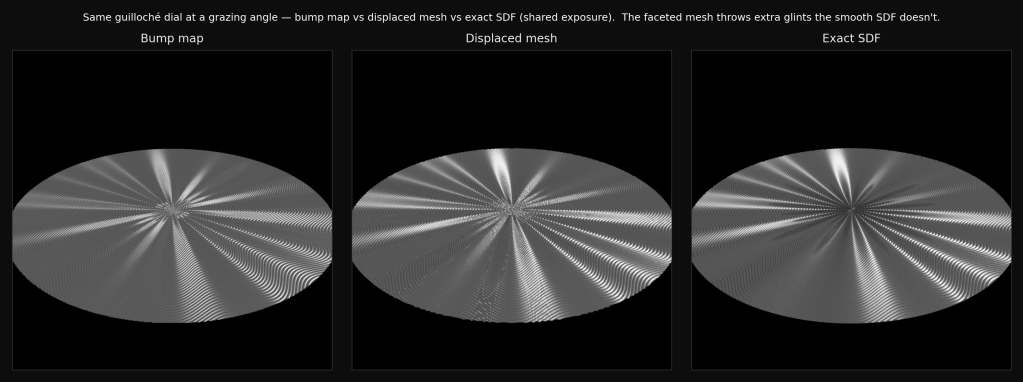
A faithful full-dial mesh at 0.20 mm pitch is 11 to 24 million triangles, and baking it transiently costs 19 to 43 GB of memory. For a dial the size of a coin. That is not a render-time number, it is a does-this-fit-in-the-machine number, and on this machine it does not. (There is a lesson buried here about the Mac Studio I did not order with 128 GB of RAM. Had I bought the bigger box, 43 GB would have fit, I would have shrugged, accepted the mesh, and moved on, and none of what follows would have happened. Under-specifying my own hardware turned out to be the single best decision in the project, which is not a sentence I expected to write.) The original plan had been a fine displaced mesh with anisotropic shading and no bump mapping (I had rejected bump as an off-brand fake), and the measurement phase demolished the plan. The right response to a wall is not to argue about which technique you prefer; it is to build all the candidates and score them. So the plan became a three-way study: realize the same dial as a bump map, as a displaced mesh, and as an exact signed-distance surface, from one shared kinematic field and one shared material, and measure each against the exact surface as ground truth. A number, not a dogma.
The verdict, with the trap inside it
The exact signed-distance surface holds 0.23 GB regardless of pitch, because it never tessellates; it evaluates the height function analytically as a ray marches it. The displaced mesh at a coarse, demo-able pitch is fast to trace (about five times faster than the exact surface) but already wants 3 GB, and at honest pitch it walks straight into the 19-to-43 GB wall. So the deciding axis is memory, not trace time, and the exact surface is the only memory-feasible representation of the full dial at real pitch. That single fact is why it got promoted from a benchmark curiosity to the production path.
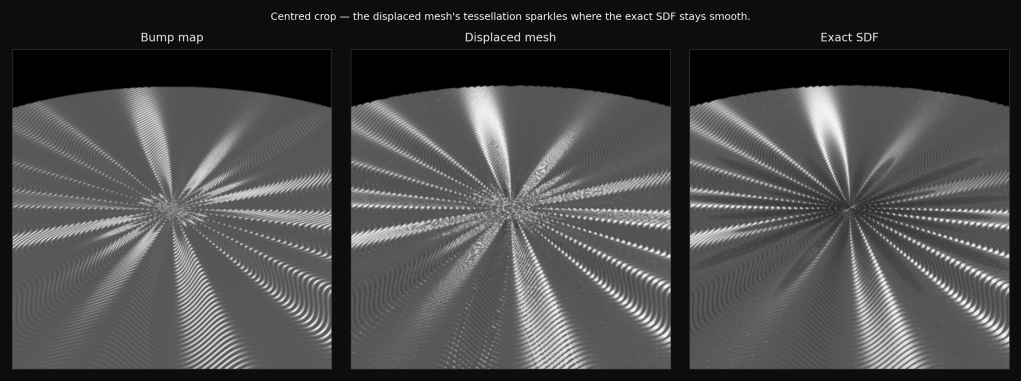
And “exact” turns out to matter for this particular look, not as a purity argument but visibly. Under flat, diffuse lighting all three realizations agree to about 95 percent; geometry barely shows. But the guilloché look is a sharp directional flash raking across the grooves, and under that flash the faceted mesh deviates from the smooth exact surface, because the flat facets throw glints the smooth surface does not. That extra sparkle reads as detail and is in fact an artifact: it is the tessellation, not the metal. The smooth analytic normal is the honest one.
The trap in the study was a measurement trap, and it cost me a couple of hours and some dignity. The first pass reported that bump mapping “did not engage at any scale” and disqualified it, which sounded like a plumbing bug. It was not; it was a unit mismatch. The bump strength and the mesh displacement were set to the same number, but they are different units, and the legacy bump’s amplitude secretly couples to its sampling window, so the value that matched the mesh was about eight times too weak and the dial rendered flat. Fixed (with an opt-in flag that makes the strength window-independent, default off so every existing scene stays byte-identical), the bump suddenly carried the full twelve-lobe rosette. And then the second trap: the now-working bump scored a higher error against the exact surface than the broken flat one had. Not because it was worse, but because root-mean-square error rewards the conditional mean, and a featureless grey disc is an excellent approximation of the average of a textured one. A flat disc scores low error with zero structure. The lesson, which generalises well past rendering: never read RMSE without a structure metric beside it, or you will congratulate yourself for predicting nothing. The honest verdict is that bump is the lightest and fastest of the three and reproduces the pattern fine head-on; it loses to the exact surface only when the shot tilts into grazing relief, where a normal-only fake has no self-shadow, no parallax, and no silhouette, which is exactly where guilloché earns its keep.
III. RISE grows an implicit primitive
The study needed an exact surface, and separately the watch case needed organic, melded forms: flying-blade lugs that flow into the bezel, a ribbed gear of a crown. Both pointed at the same missing capability, so RISE got its first implicit-geometry primitive: a signed-distance field, a surface defined as the set of points where a distance function reads zero, ray-traced by sphere tracing (you step along the ray by as much as the known distance to the nearest surface, which is always safe because nothing can be closer than that, and you close onto the surface without ever tessellating it). It is a list of distance primitives (spheres, boxes, rounded boxes, cylinders, tori, capsules, cones) composed with union, smooth-minimum (which gives the molten fillet where two forms blend), subtraction, and intersection. It was built for the watch’s lugs, and named and shaped so that nothing in it knows what a watch is, which is a rule I will come back to.
The directive I set myself was that it be a first-class citizen, not a guarded stub: real mesh generation and real surface sampling, not bounding-box fakes. Real meshing meant a marching-tetrahedra mesher (I chose tetrahedra over the more famous marching cubes because the cubes algorithm’s 256-case table cannot be safely hand-written, and a watertight, unambiguous mesh mattered more than familiarity). Real surface sampling meant that an emissive signed-distance surface is a genuine light the renderer can aim shadow rays at, which I validated by Monte-Carlo-integrating the lighting integrand against the closed form and getting a ratio of 1.00019. The machinery is provably unbiased, which is the sort of sentence that is boring to write and very reassuring to have.
The black-glass bug
The gem of this stretch was a bug that rendered a glass signed-distance object solid black, and its cause is two correct-in-isolation pieces conspiring.
When a ray refracts into glass, the renderer spawns the continuation ray exactly at the surface point, with no offset. That is correct. Separately, a sphere tracer reports its hit a hair before the true surface, because it marches until the distance drops below a small epsilon and stops just shy of the zero crossing. That is also correct. Put them together and the refracted ray, born exactly on the reported hit, is actually a hair outside the true surface; it immediately re-hits the same surface band it was just spawned on, the renderer concludes the ray travelled an infinitesimal distance through glass and then another and another, and the interior medium absorbs over what is effectively an infinite path. Black. The fix is to step the ray off the surface band before deciding which side of the glass it is on, which is exactly the trick analytic primitives use to reject the spurious “I hit myself at distance zero” root. It is a general correctness fix for any glass implicit surface, and it only became visible because the watch needed glass with an interior medium. This is the recurring shape of the whole project: the interesting bugs live at the seams between components that are each individually right, and the way you get to meet them is to build the thing yourself.
A small family of related bugs surfaced the same way and each got fixed at its own layer: bounds that grew wrong when a watch crystal’s huge dome blew the box out to dead space (the union-of-boxes was order-blind, and the first fix for it was also order-blind, caught by review before it shipped); an “invisible lume” bug where a wide, thin emitter’s bounding pad was thinner than the marcher’s surface band, so camera rays entered already inside the surface and reported the exit face, silently skipping the tops of the lume batons (glowing sides, dark tops). None of these are exotic once found. All of them are invisible until an implicit surface makes you confront the gap between a bounding box and a true surface.
And one more measurement trap, because they cluster. A signed-distance emitter has about twice the pixel variance of an analytic one, for a real reason (its surface-curve sampling fragments the stratification at the visibility boundary). Through an 8-bit sRGB PNG, that extra noise reads as a fake four-percent brightness deficit, because clipping and the concave display transfer interact with noise the way Jensen’s inequality says they will. I spent real time chasing a brightness bug that did not exist. The rule that came out of it is blunt: compare emitters in linear high-dynamic-range, never through an 8-bit preview, because the preview is not a neutral observer of brightness when noise is in play.
IV. The boring twenty-five-x
Here is the least glamorous and most quietly important thing I built, and it never appears in a single pixel of the final image.
The watch scene defines six dial patterns but renders only one; the other five are an artistic library I flip between in the GUI. Under the old model, parsing the scene baked all six displaced meshes, spending minutes and gigabytes on five dials that never appear on screen. The fix is to defer all the expensive parse-time work into a single realize pass that runs once, on a single thread, at the precise moment the scene becomes immutable and just before the parallel render starts. (Deliberately not lazily during the render itself, because the scene is shared and immutable across all the render threads, and realizing geometry there would be a data race wearing a convenience costume.) A small freeze gauge asserts, loudly and in every build, that nothing tries to realize during the parallel pass, so the invariant is exercised by the whole test suite rather than trusted.
The payoff on the watch: parse 25 times faster (17.55 seconds to 0.69), parse memory 6.4 times smaller (3.74 GB to 586 MB), total wall time 2.3 times faster, and provably behaviour-neutral (the before-and-after images differ only at the renderer’s own run-to-run noise floor, which is the only honest way to prove a change like this is neutral, because the multithreaded integrators are not bit-deterministic and “exact zero difference” is a fantasy).
There was a second phase available, deferring the painters and image decodes too, and I scoped it, found it was a roughly 75-class recursive cascade with five separate correctness landmines, noted that the motivating case was already solved and the remaining cost was an environment map that is almost always used anyway, and did not do it. Knowing where to stop is a feature. The most expensive code is the code you write to solve a problem you do not actually have.
V. Finishing the dial, and two times the watch lied to me
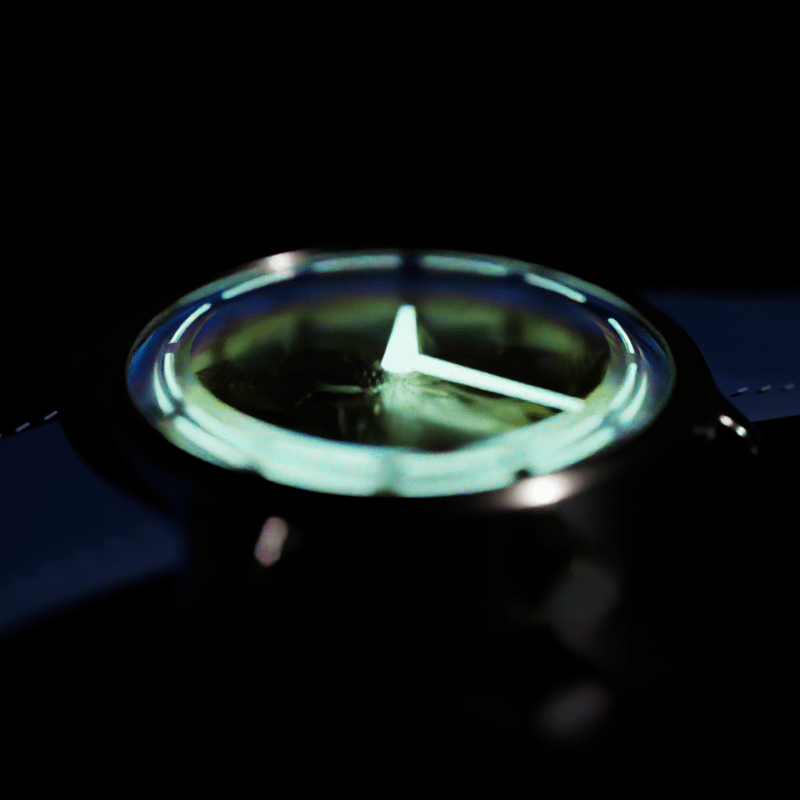
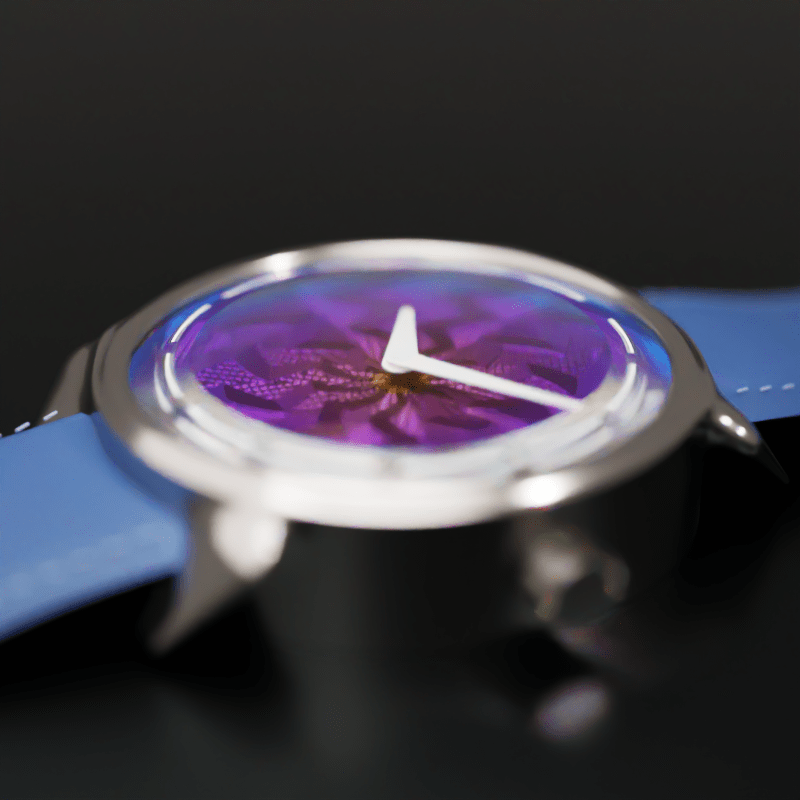
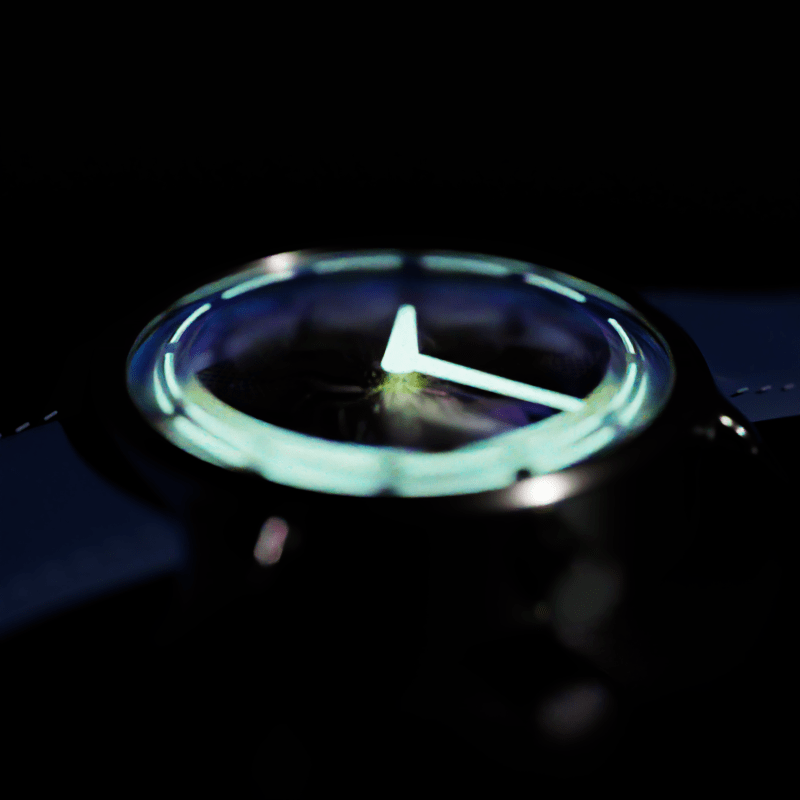
With honest optics, an exact surface, and a fast parse, the dial could finally be finished as the actual Lightning motif: eleven jagged radial bolts, the in-bolt grooves running straight but re-angling at every zigzag of the bolt, and the finer sector grid kept between the bolts. I assembled it under a real double-domed sapphire crystal (two concentric spheres, a roughly 1.2 mm wall, with the hour markers cut as cavities into the underside and filled with inset lume, the way the real watch etches them), and shot it on a macro rig built the way watch photographers actually work: a 100 mm lens on a full-frame sensor at f/16, lit off-axis so no light sources sit in frame, the watch laid on a dark glossy tabletop that fades to black. Then the watch lied to me twice.
The fifteen-nanometre lie
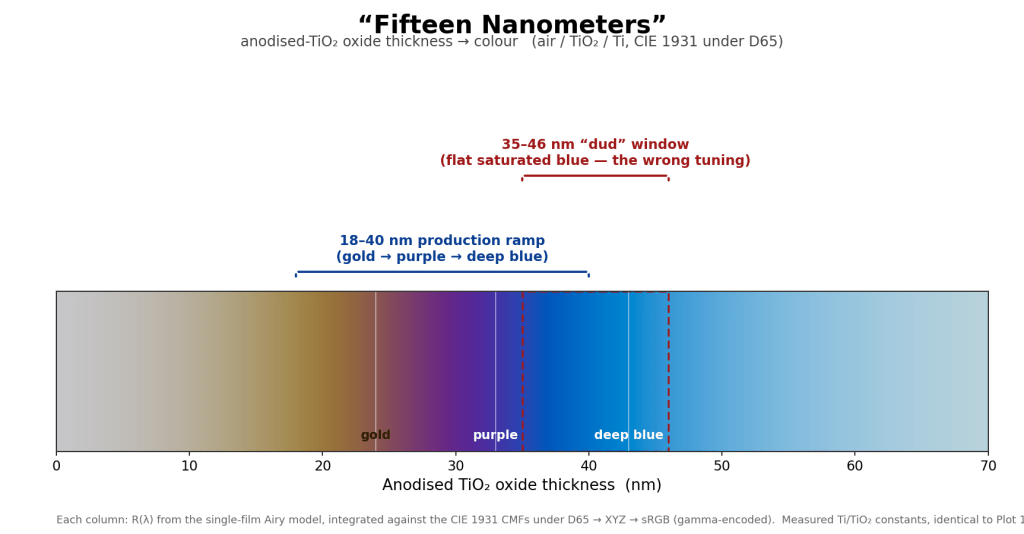
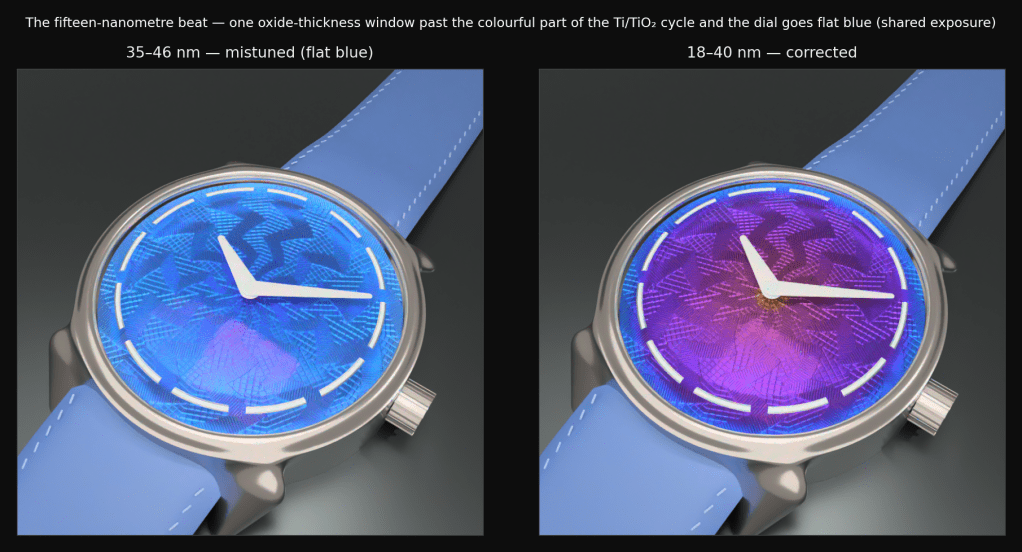
I had tuned the dial’s color on a fast RGB preview, the convenience path, using scalar indices of refraction. On that preview the bronze-to-purple-to-blue interference cycle landed across a thickness sweep of 35 to 46 nm, so I set the production oxide ramp to sweep 35 to 46 nm from centre to rim, hit render on the real spectral path, and got a dial that was flat, sulking deep blue. No gold. No purple. A blueberry.
The diagnosis is the title of this essay. The production material uses measured spectral optical constants for titanium and TiO₂, not the scalar approximations the preview used, and the same color cycle lives about fifteen nanometres lower on the real material. At 35 to 46 nm the real titanium was already fully into saturated blue, past the colorful part of the cycle entirely. A thin-film color tuned on a scalar swatch simply does not transfer to the real spectral material; they are not interchangeable per thickness, and nothing warns you, because each is internally consistent.
The tool that nailed it is the obvious one in retrospect: render a spectral swatch of the actual material, a flat panel with the exact measured constants and a thickness gradient, on the real spectral path, and read the thickness-to-color map straight off it. With that map, the ramp re-tuned to 21 to 40 nm, then to 18 to 40 nm with a deliberately thin gold centre, and the dial finally read gold at the centre, purple through the middle, deep blue at the rim. The general rule is now a law I keep: tune a thin-film color against the material the hero actually renders, not a convenient proxy.
And this is the place where I have the most respect for the people who made the real watch, because they cannot cheat the way I did. My fifteen-nanometre window is a number I can dial in with measured spectra and a swatch render. Theirs is a butane torch and a man’s eye and the moment he decides to pull the heat. The reason so many of the real Lightning dials get scrapped (Ming has put the reject rate as high as two thirds) is that same narrow window, except he is hitting it by hand, on a guilloché surface whose grooves heat unevenly, on titanium whose crystalline structure, by the brand’s own account, can betray the color at the last second. I spent two days finding the window with instruments. He finds it with a flame, and throws away the ones that miss. After this exercise I understand exactly how thin that margin is, and I did not understand it before.
Which reframes the price, too. The 6,250 francs I mentioned up top looked steep for a steel watch with a hand-wound Sellita inside, a spec sheet that elsewhere costs a third of that. It looks different now. You are not paying for the movement. You are paying for a hand-cut guilloché surface and a hand-torched color with a brutal yield, and once you have felt how narrow the window is, the number stops reading like a markup and starts reading like an honest tally of everything that has to not go wrong.
The blurry-crystal lie
The second lie was subtler. The dial looked faintly soft, blurred, when viewed through the crystal, and the obvious suspect was the crystal: refraction, lensing, the dome acting as a bad magnifier. I almost spent a day on the optics of the dome.
It was innocent. A concentric meniscus shell, inner and outer surfaces sharing a centre, is afocal; it bends light on the way in and bends it back on the way out, and does not blur anything. The real culprit was the denoiser. The dial was being lit almost entirely through stochastic refraction (the direct-lighting shadow rays were being blocked by the glass shell, because a shadow ray treats the crystal as opaque), so the dial pixels were extremely noisy, and the denoiser, doing its job on garbage, smeared the noise into softness. I proved it with a clean A/B at high sample count with the denoiser off: through the crystal and with the crystal removed entirely, the raw images were equally sharp (and equally noisy). The geometry was never the problem. The fix is a general engine feature, transparent shadow rays: let a shadow ray pass through a clear dielectric, attenuated by the per-surface Fresnel transmittance, instead of treating glass as a wall. The dial snapped crisp. Both lies share a moral I will state once: the obvious suspect is usually innocent, and the cost of arresting it is the day you do not spend on the actual culprit.
VI. Making it move
The whole point of this watch is the flash. The anodized shimmer and the specular highlights are the look, and a still can only ever show you one instant of them. So the turntable had to be high-dynamic-range, and the existing movie writers were 8-bit, which clamps everything brighter than white to white and crushes every highlight the watch is famous for into a flat sheet. I rebuilt the export to an HDR10 ProRes 4444 master: take the renderer’s scene-linear output, convert from Rec.709 primaries to Rec.2020, encode through the PQ transfer (which keeps headroom above reference white so highlights survive the codec’s integer quantisation), and tag the result as HDR10. Two color-science bugs got caught in review along the way, both instructive: encoding through a linear transfer re-clips the highlights at the integer encode even though the float buffer held them fine (HDR in a codec needs a transfer with headroom, which is the whole point of PQ), and tagging Rec.2020 onto Rec.709 data without actually remapping the gamut produces oversaturated color in any color-managed player. Either convert the colors or tag them honestly; do not tag what you did not convert.
The atom that wasn’t there
And then the best bug of the entire project, the one I will be telling for a while.
The headless encoder produced a file that was HDR in its pixels, HDR in its bitstream color tags, and reported as correct HDR by every probing tool I pointed at it. And it played back as standard-dynamic-range. Flat. The pixels were right, the tags were right, the tools agreed with me, and the picture was wrong.
I found it by dumping the low-level atoms of two files side by side, mine and a known-good one from the GUI path, and diffing. The good file had a tiny container-level atom called colr; mine did not. It turns out QuickTime and macOS decide whether to engage HDR off that container atom (nclc: pri 9 trc 16 matrix 9, meaning Rec.2020 / PQ / Rec.2020), not off the ProRes bitstream tags that every probe tool reads and reports. The bitstream tags are real, and read correctly, and the player ignores them. Worse, the obvious flag to force the atom writes a different, useless atom (marked “unspecified”) because the color flags do not reach the relevant muxer. The working recipe is to stamp the frame parameters and force the atom explicitly, and to verify with a single grep that the atom reads pri 9 trc 16 matrix 9, identical to the GUI output that was never broken. An entire afternoon, an HDR pipeline that was correct in every component, defeated for want of one container atom. I wrote the whole workflow down as a reusable skill so I never have to rediscover it, which is the only revenge available against a bug like that.
The animation itself was authored in RISE’s native keyframe timeline, no script: a turntable orbit with the lights held fixed so that the specular highlight sweeps across the guilloché and the thin-film colors shimmer as the dial turns, which is the entire reason for making it move at all. (One standing rule the watch reinforced and I will pass along: keep the denoiser on for presentation renders. I once turned it off for an animation out of a flicker worry, and was overruled, correctly and emphatically. At high sample count the denoise is light, and a steady standing preference beats a clever one-off aesthetic theory every time.) The watch later grew running hands, each hand a small implicit cone whose orientation is keyframed about the hub, which is a pure scene change and needed no new engine feature, exactly as it should be. (Like the real Lightning, mine carries no seconds hand; Ming left it off on the grounds that the dial was busy enough without one more moving thing reminding you that time is passing, and I saw no reason to argue with him. The hour and minute hands sweep, which is plenty to make it feel alive.)
VII. The discipline
The technical work above would have collapsed under its own weight without a process, and the process is as much the deliverable as the renders. I ran this the way I increasingly run everything: as a master-controller session directing worker subagents, with the humans (me) holding the parts that must not be automated.
Three rules carried it. First, every non-trivial change was validated by two or three independent reviewers, each given an orthogonal concern (the optics maths, the spectral integration, the API and lifecycle, the thread-safety, the blast radius) and run in parallel; the thin-film merge alone went through three rounds and nine reviewers. This is not a rubber stamp, and the proof is that it found real bugs before they shipped: a material that dereferenced an optional parameter unconditionally and segfaulted on a documented-as-supported scene, the order-blind bounds fix that was itself order-blind, a photon-map classification that would have rendered a dispersive-caustic test black. Implement, review on orthogonal axes, fix every finding, then declare done.
Second, features must be general. The test I apply is simple: would this chunk look reasonable in the engine’s feature list, next to “sphere” and the Perlin painters? If its description needs the watch to make sense, it is wrong. This is why so much of the work was excision. A “watch strap geometry” I had written early was a scene generator wearing an engine-feature costume, and it got deleted and replaced by two genuinely general primitives (a profile swept along a path with rotation-minimising frames, and a template stamped along a path), with the strap’s actual cross-section moved out into the scene file as authored data, derived in a comment. The guilloché field itself eventually dissolved the same way, into a general in-scene maths-expression evaluator, deleting a couple of hundred lines of pattern-specific C++; the proof of equivalence was a dense fifty-thousand-point sweep that matched bit-exact. The watch scene is now fully procedural, no baked meshes and no baked textures, and the truth of the dial is readable in the scene text. Every excision left RISE more capable than the watch required, which is the entire return on the discipline: the watch was the muse, and the engine kept the technique.
Third, trust the measurement before the conclusion, and cross-check the tool. The three-way study is the canonical instance (a number, not a dogma), but the theme runs through everything: the RMSE-versus-structure trap, the compare-emitters-in-linear-HDR rule, the behaviour-neutral proof against the noise floor, and a sibling lesson from elsewhere in the codebase that I keep taped to the inside of my skull, which is never trust a tool that reads through the suspect component. (The EXR reader had been silently clipping very bright values on read, so a “the integrator produces infinities” verdict turned out to be a reader artifact, not an integrator bug. The bug was in the instrument.)
A few environment traps were vicious enough to institutionalise, and they are worth a paragraph because they are the kind of thing that is never in a paper and always in the work. The build compiles with fast-math, under which infinity does not behave, and an infinity-seeded min/max reduction in the dial bake produced uniformly 37-times-compressed heights while the identical source compiled without fast-math was correct; the fix is to never seed a reduction from infinity and never write a NaN guard that assumes IEEE semantics you have told the compiler to discard. The source is hard-tab indented and the editor renders tabs as spaces, so a multi-line edit reconstructed from what you see silently mismatches what is on disk. And the shell does not word-split an unquoted variable the way I assumed, so a list of frames collapsed into one impossibly long filename. None of these are interesting. All of them cost time, and all of them are now written down, because the second time you lose an afternoon to fast-math is the afternoon you should have read your own notes.
I will say one honest thing about the human-and-machine arrangement, because it is my actual day job and I think the shape of it matters. The machine is extraordinary at the breadth: holding a 99-commit feature branch in view, running adversarial reviewers in parallel, enumerating every sibling of a bug pattern, writing the swatch test that disproves the brightness deficit. The judgement that did not delegate well was the taste: refusing to relax the pitch, rejecting the color gradient as a model, deciding not to implement the famous paper, knowing when to stop the deferral work. The interesting frontier is not whether the machine writes the code (it does, well) but where exactly the irreducible human judgement sits, and on this project it sat almost entirely in choosing the constraints and refusing to bend them. The workers never committed and never pushed; the controller verified independently and committed to a branch; only the human pushed. That last rule is not about trust in the machine. It is about who is accountable for the artifact, which is still, for now, a person.
Coda
What I came away with is not a render I am proud of, though I am, and not a longer feature list for the engine, though that too. It is an appreciation I am fairly certain I could not have reached any other way.
Before this, I would have looked at the Lightning and seen a very pretty dial. Now I see the specific, unforgiving things that had to go right to make it. I know what a rose engine is doing, that the pattern is a recorded motion and not a drawing, and roughly how much control it takes to feed a cutter into titanium at that pitch without the whole figure wandering. I know that the color is not pigment but a fifteen-nanometre window of oxide, and I know it in my hands because I missed the window myself and rendered a blueberry. And I know that Josh Shapiro cuts that surface by hand and Ming Thein finds that window with a torch and his own eyes, on a metal that fights them both, throwing away the ones that miss. I had to assemble measured spectra, a swatch render, and an exact analytic surface to do, in software and imperfectly, a thin sliver of what the two of them do with a lathe and a flame.
That is the part that surprised me. I went in expecting to understand the physics, and I did. What I did not expect was to come out the far side with so much more respect for the craft, precisely because I now know which parts of it are hard and why. The bugs were the teachers in all of this, every one of them: the black glass, the fifteen nanometres, the missing atom, the flat disc that scored a suspiciously good error. Each was a place where I was sure I knew how the light worked and did not, and each one quietly moved a piece of the watch from “magic” into “earned.”
You can admire an object from across a display case. You can also take it apart in simulation, fail to reproduce it a dozen ways, and come out admiring it more, for sharper and more specific reasons. I went looking for the physics and found, instead, a great deal of respect for two people doing by hand what I could barely fake with a renderer. That trade was worth every evening.
 Aravind